
Why do so many organisers settle for washed-out visuals or screens that fail at the first sign of a coastal drizzle? Securing an outdoor LED display rental for an Irish event is a technical feat that goes far beyond simply finding a large monitor. It requires a strategic balance of high-intensity brightness and rigorous weatherproofing to ensure your content remains vivid against the greyest Atlantic sky.
It’s natural to worry that the unpredictable climate will render your investment unreadable or, worse, cause a total technical failure mid-event. We know that deciphering technical jargon like Nits and pixel pitch feels secondary to the mounting pressure of logistics and strict 13-week licensing deadlines. This guide provides the professional clarity you need to select the right screen size for your specific audience. You’ll master the essentials of IP65 ratings, understand how viewing distances impact clarity, and follow a structured roadmap for a seamless technical installation.
Key Takeaways
- Learn why a minimum of 5,000 Nits and an IP65 rating are essential for maintaining visual impact against direct sunlight and the Irish climate.
- Master the relationship between pixel pitch and viewing distances to ensure your audience enjoys a crisp, high-definition experience from every angle.
- Understand the complex power and structural safety requirements, from 3-phase power logistics to wind-loading calculations for secure outdoor setups.
- Discover why a professional outdoor LED display rental requires more than just hardware, focusing on the value of on-site technicians for real-time colour calibration.
- Contrast modular LED technology with traditional projection to understand why self-emissive screens are the superior choice for high-ambient light environments.
Understanding Outdoor LED Display Rental: Beyond the Big Screen
Choosing an outdoor LED display rental isn’t just about finding a bigger television. It’s about deploying a specialised engineering solution designed to compete with the sun. Unlike indoor screens, outdoor LED units consist of modular panels that combine to form a single, high-impact visual canvas. This technology is fundamentally different from traditional projection systems, which typically fail in outdoor environments. Daylight washes out projected images, rendering them unreadable for your audience. Modern LED display technology is self-emissive, meaning every pixel produces its own light. This allows for clear visibility even in direct sunlight or the high-glare conditions often found at Irish coastal venues.
In Ireland, where the events industry contributes over €3.5 billion annually, these screens have become essential infrastructure. They provide the reliability needed for high-stakes public gatherings where communication must be instant and clear. We commonly see these systems deployed for:
- Large-scale Festivals: Providing live stage feeds and safety information to thousands of attendees.
- Sporting Fanzones: Delivering high-definition match coverage in public squares and parks.
- Corporate Launches: Creating a premium atmosphere for brand activations and outdoor press events.
LED vs. LCD: Why Direct-View LED Wins Outdoors
Direct-view LED wins because it doesn’t rely on a backlight. Each diode creates the image directly, resulting in significantly higher brightness levels than consumer or commercial LCDs. Standard LCD screens also suffer from bezels, which are the plastic frames around the edge of the glass. When you tile LCDs together, you get a distracting grid effect. LED walls are bezel-free, creating a seamless image regardless of the total size. Additionally, LED components are incredibly robust. They lack the fragile, glass-fronted surfaces of LCDs, making them far better suited for the rigours of outdoor transport and installation.
The Role of Modular Design in Modern Events
Most professional systems utilise 500mm x 500mm panels. This modularity is a primary reason why outdoor LED display rental has become the standard for Irish festivals and urban events. It allows us to build screens in any aspect ratio, from standard 16:9 to ultra-wide cinematic strips. Some panels are even curvable, enabling concave or convex shapes for immersive brand activations that wrap around a stage or architectural feature.
This design also solves logistical headaches. In tight urban environments like Dublin’s city centre, moving a massive single screen would be impossible. Modular panels are easily transported in flight cases and assembled on-site. This flexibility ensures that high-impact displays can be installed in even the most restricted venues, allowing for bespoke visual experiences that wouldn’t be possible with fixed-size alternatives.
The Technical Essentials: Brightness, Nits, and Weatherproofing
Technical specifications often look impressive on paper, but their real-world application determines the success of your outdoor LED display rental. Visibility and durability are the two pillars of any successful open-air broadcast. Without sufficient luminance, your content disappears. Without proper weatherproofing, the entire system is at risk. Professional hardware must be engineered to withstand both high-ambient light and the unpredictable Irish climate.
Modern screens utilise auto-brightness sensors to manage these variables. These light-sensitive modules adjust the output in real-time, ensuring the display is never too dim during a bright afternoon or too piercing as the sun sets. This intelligent regulation protects the audience’s eyes whilst significantly lowering energy overheads. Robust thermal management systems are also built into every panel. Even if the air temperature feels mild, direct solar gain can cause internal components to overheat. Integrated cooling fans and heat-dissipating aluminium frames keep the hardware within safe operational limits, preventing diode failure or colour shifting.
Adhering to professional event safety guidelines involves more than just structural checks; it requires ensuring all electrical components are rated for their specific environment. When you hire professional rental equipment, you’re investing in hardware that has been rigorously tested for these conditions.
Combating Sunlight: Why 5,000 Nits is the Minimum
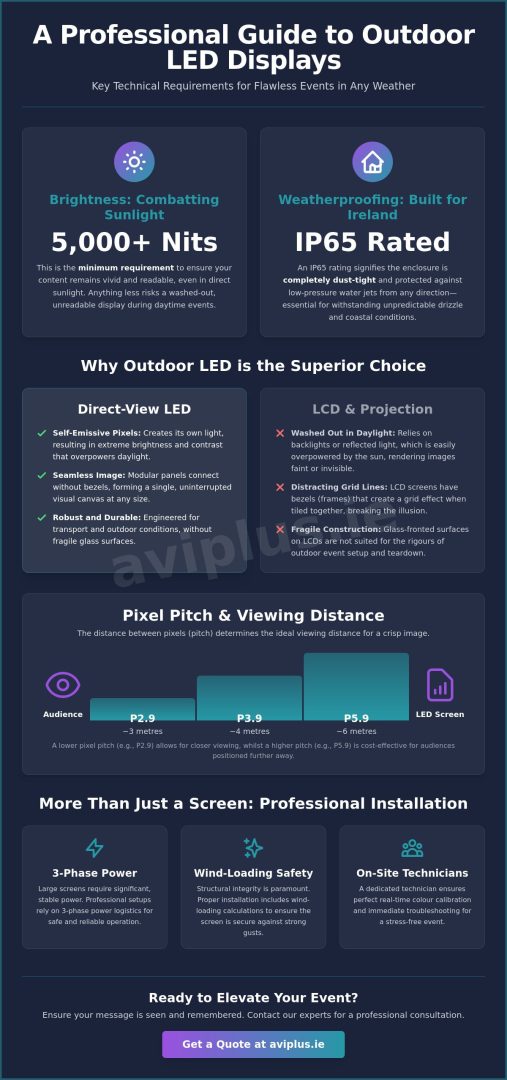
Luminosity is measured in Nits, where one Nit is equivalent to the light of one candle per square metre. Whilst an indoor screen might only require 1,000 Nits, outdoor environments demand much more. You also need a high contrast ratio to ensure that dark areas of your video don’t turn into a grey haze. “In the height of an Irish summer, a screen with fewer than 5,000 Nits will appear washed out and unreadable.” High-end rental panels often reach 6,000 or even 7,500 Nits to guarantee absolute clarity regardless of the cloud cover.
IP Ratings: Protecting Your Event from the Irish Rain
An Ingress Protection (IP) rating tells you exactly how much moisture and dust a screen can handle. For Irish events, an IP65 rating is the industry benchmark. The first digit, ‘6’, means the unit is entirely dust-tight. The second digit, ‘5’, confirms protection against water jets from any angle. Crucially, this protection must extend to the rear of the panels where the power and data connections reside. We utilise waterproof Neutrik connectors and sealed cable management systems to ensure that even a heavy Atlantic downpour won’t interrupt your programme.
Pixel Pitch and Viewing Distance: Finding the Sweet Spot
Selecting the correct resolution for an outdoor LED display rental depends entirely on the physical layout of your venue. The most critical metric here is pixel pitch, which refers to the distance from the centre of one LED cluster to the centre of the next, measured in millimetres. This measurement dictates the minimum distance at which an image appears crisp and cohesive rather than a collection of individual dots. A smaller pixel pitch results in higher pixel density and greater detail, but it requires a more significant investment due to the increased number of diodes per square metre.
An inverse relationship exists between pixel pitch and viewing distance. As a general rule, a 1mm pitch corresponds to roughly one metre of viewing distance. If your audience is positioned 10 metres away, a P10 screen will look perfectly sharp. However, if that same audience moves closer, the image will begin to look pixelated. Finding the “sweet spot” involves choosing the largest pixel pitch possible that still maintains a high-definition appearance from the front row. This approach ensures you don’t overspend on resolution that the human eye cannot perceive from a distance.
The Pixel Pitch Comparison Table
| Pixel Pitch | Minimum Viewing Distance | Typical Event Use |
|---|---|---|
| P3.9 | 3.5 – 4 Metres | Corporate launches and luxury brand activations. |
| P4.8 | 4.5 – 5 Metres | Medium-sized festivals and city centre fanzones. |
| P6.0 | 6 – 7 Metres | Large concert stages and public information boards. |
| P10.0 | 10 – 12 Metres | Massive stadium screens and high-altitude signage. |
By 2026, P3.9 has emerged as the professional standard for high-end corporate outdoor events in Ireland. As brands aim for more immersive experiences, audiences are often encouraged to stand closer to the hardware for interactive elements. This shift requires the finer detail that only a sub-4mm pitch can provide whilst still maintaining the high-brightness levels discussed in previous sections.
Calculating Your Ideal Screen Size
Matching your screen dimensions to your audience capacity is an exercise in both geometry and logistics. Whilst a larger screen is always more impressive, it must be scaled to the venue’s footprint. We often use the “Height x 10” rule to determine the maximum effective viewing distance. For example, a screen that is 3 metres high will be comfortably viewable for guests up to 30 metres away. Beyond this point, fine text and small details become difficult to distinguish.
It is important to remember that LED screen hire prices Dublin are heavily influenced by the total square metreage of the display. By calculating your exact needs based on audience location, you can optimise your budget without sacrificing the visual impact of your event.
Planning Your Event: Logistics, Power, and Content
Executing a flawless outdoor LED display rental requires a rigorous logistical framework that extends far beyond the screen itself. Whilst the technical specifications of the panels are vital, the infrastructure supporting them determines the reliability of your broadcast. We begin every project with an early site survey. This step is essential to identify potential signal interference from local telecommunications masts or heavy industrial machinery that could disrupt the data feed. Identifying these hurdles early allows us to plan cable routes and signal boosting accordingly.
Structural safety is non-negotiable, especially given the unpredictable gusts common across the Irish landscape. Wind-loading calculations must be performed for every installation, whether you utilise ground stacks or truss flying. Ground stacks involve securing the screen to a weighted base, whilst flying involves suspending the panels from a certified truss structure. Both methods require precision engineering to ensure the wall remains stable in adverse weather. To prevent a total blackout, we implement dedicated LED processors and redundant backup signal loops. If a primary data cable is compromised, the secondary loop takes over instantly, ensuring your programme continues without interruption.
Powering Your Outdoor Display
Large-scale LED walls demand significant electrical capacity, typically requiring 3-phase power or specialised event generators. It’s important to distinguish between peak power draw, which occurs when every pixel is at maximum white brightness, and average power consumption during standard playback. You must provide a “clean” power source to protect the sensitive diodes from voltage spikes. We use professional power distribution units (PDUs) to balance the load across the modular panels and prevent circuit overloads that could lead to hardware damage.
Content Strategy for Large-Format LED
Content design for the outdoors differs significantly from traditional digital media. Whilst 16:9 is the standard aspect ratio for video, bespoke stage designs often require custom resolutions and non-standard shapes. Legibility is the priority. We recommend using high-contrast colour palettes and avoiding small, serif fonts that can become blurred at a distance. If you’re unsure which hardware best suits your creative vision, you can read our detailed guide on how to choose the perfect LED screen for events for further content optimisation tips.
Ready to ensure your event infrastructure is technically sound? You can consult with our technical specialists to plan your power and structural requirements.
Partnering for Success: Professional AV Rental in Dublin
Whilst it may be tempting to consider dry hire for smaller projects, we rarely recommend this for a professional outdoor LED display rental. The technical complexity of these systems, combined with the structural and electrical risks involved, necessitates a managed service. A high-impact display is only as effective as the team supporting it. When you partner with a specialist, you aren’t just hiring hardware; you’re securing a comprehensive technical solution that ensures your programme runs without a hitch. We encourage organisers to view screen rental for events Dublin as a full-service commitment to quality and safety.
The presence of on-site technicians is a critical factor in event success. These experts perform real-time colour calibration to ensure that your visuals remain consistent as the ambient light shifts from afternoon sun to evening twilight. They provide immediate troubleshooting for signal issues and monitor the health of the power distribution system throughout the day. This level of proactive support is what separates a standard screen hire from a premium event experience, providing peace of mind that allows you to focus on your audience rather than the hardware.
Why a Technical Site Survey is Non-Negotiable
Success begins long before the first panel is lifted. A technical site survey is a mandatory step in our process. During this assessment, we check ground stability to ensure it can support the significant weight of a large-scale outdoor LED display rental. We also map the sunlight path to determine the optimal screen orientation for maximum visibility and minimum glare. Signal paths for live video feeds are analysed to prevent dropouts, and we establish strict safety protocols for all public-facing installations. This methodical approach ensures that every structural and technical variable is accounted for before the event begins.
The AVI Plus Difference: Commercial Reliability
Our commitment to excellence is reflected in our choice of hardware. We exclusively utilise commercial-grade screens designed for the rigours of professional use, avoiding the fragile components found in consumer-grade alternatives. Based in Swords, our team provides dedicated local support for corporate conferences, high-end retail activations, and large-scale public festivals across the country. We understand the high stakes of the Irish events industry and provide the reliability required to meet those demands. If you are ready to elevate your next project, you can contact AVI Plus for a bespoke outdoor LED rental quote today.
Elevating Your Event Visuals for 2026
Success in modern event production requires a shift from simple screen hire to a comprehensive technical strategy. You’ve mastered how high-brightness, 5,000+ Nit commercial panels and rigorous IP65-rated weatherproofing act as the first line of defence against the Irish elements. By matching pixel pitch to your specific audience layout and addressing the logistical demands of 3-phase power, you ensure a broadcast that is as reliable as it is visually stunning. Technical precision is the foundation of every great show.
Choosing a professional outdoor LED display rental is the most effective way to guarantee clarity and impact in high-ambient light environments. At AVI Plus, we combine premium hardware with expert technical support based in Swords, Co. Dublin, to manage every detail of your installation. We’re here to ensure your content performs flawlessly from the first frame to the final curtain.
Request a Professional Outdoor LED Rental Quote from AVI Plus to begin planning your next high-impact activation. We look forward to helping you transform your vision into a flawless reality.
Frequently Asked Questions
Can outdoor LED screens be used in heavy rain?
Yes, professional outdoor screens are specifically engineered to operate in heavy rain. Our systems carry an IP65 rating, which means they’re completely dust-tight and protected against water jets from any direction. We use sealed Neutrik connectors and waterproof cable management to ensure the electrical components remain dry. This allows your event to continue safely even during a typical Irish downpour without risking hardware failure or electrical hazards.
How much power does an outdoor LED wall actually need?
Power requirements vary by size, but a standard large-scale outdoor LED display rental typically requires a 3-phase power supply. For a medium wall, you might need between 15kW and 30kW at peak brightness. It’s vital to distinguish between peak draw and average consumption, as the latter is often 30% to 40% lower. We always recommend using a dedicated event generator or a certified mains connection to provide the “clean” power needed for sensitive diodes.
What is the difference between pixel pitch P3.9 and P4.8?
The difference lies in the distance between the centres of the pixels. A P3.9 screen has pixels spaced 3.9mm apart, whilst a P4.8 screen has a 4.8mm gap. This means P3.9 offers higher resolution and a closer minimum viewing distance of approximately 4 metres. P4.8 is a robust, cost-effective choice for larger festivals where the audience is situated further back, typically 5 metres or more from the stage.
How bright should an outdoor screen be for a sunny day in Dublin?
You should aim for a minimum brightness of 5,000 Nits to compete with direct sunlight in Dublin. Whilst Ireland is known for cloud cover, solar glare can still wash out lower-quality screens. Professional commercial panels often reach 6,000 to 7,500 Nits, which provides the high contrast ratio needed for vibrant colours. This ensures your content remains readable even when the sun is positioned directly behind or in front of the screen.
Do I need a special permit for a large outdoor LED screen?
You’ll need an Outdoor Events Licence if your audience exceeds 5,000 people, as per the Planning & Development Act. This application must be submitted to your local authority at least 13 weeks before the event. For smaller setups, you generally don’t need a specific permit for an outdoor LED display rental, but you must ensure the structure complies with local safety regulations and doesn’t obstruct public rights of way.
Can I show live TV or sports on a rented LED wall?
Yes, you can broadcast live TV and sports by connecting a satellite or cable receiver to a professional LED processor. This setup allows for real-time scaling and colour correction to ensure the broadcast fits the screen’s bespoke dimensions perfectly. It’s important to remember that you’re responsible for the appropriate commercial broadcasting licences, such as those required for public screenings of major tournaments or subscription-based sports channels.
What is the typical setup time for a 12-square-metre LED screen?
A 12-square-metre screen typically takes between three and five hours to set up fully. This timeframe includes the assembly of the modular panels, structural securing (either ground stacking or flying), and the final signal testing. We also allocate time for colour calibration and content walkthroughs to ensure everything is perfect before the doors open. Larger or more complex curved installations will naturally require a more extended pre-event build schedule.
How do I ensure my content looks sharp on a large outdoor display?
Sharpness is achieved by matching your content’s resolution to the screen’s native pixel map. Avoid using small, serif fonts, as these can blur at a distance; bold, sans-serif typefaces are much more effective. High-contrast colour schemes, such as white text on a dark background, significantly improve legibility outdoors. Always work with your technician to test your files on the actual hardware during the site build to verify clarity and colour accuracy.


