
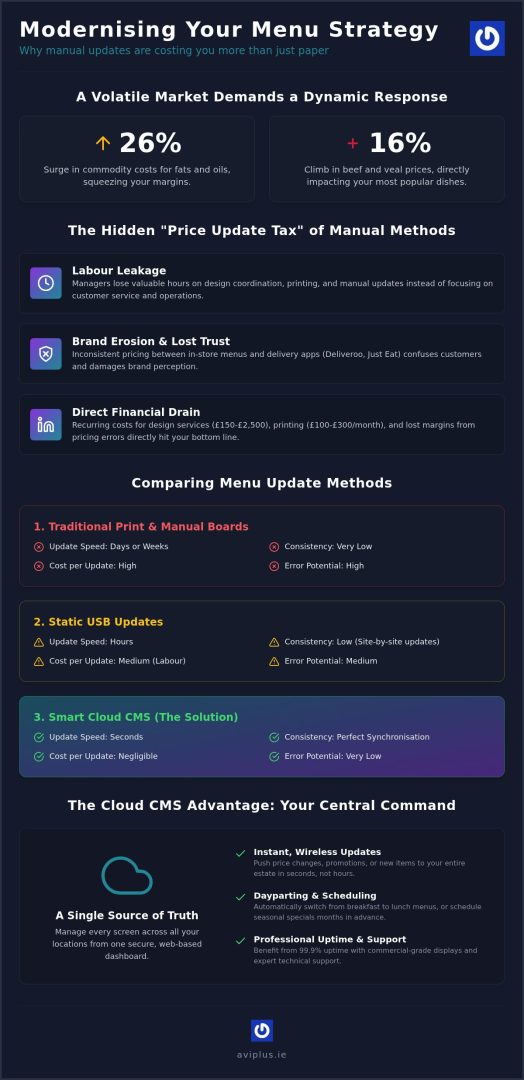
With commodity costs for fats and oils surging by 26% and beef prices climbing by 16%, your pricing strategy can no longer afford to be static. Relying on slow, manual methods means you’re likely losing revenue every hour your prices remain unadjusted. Learning how to update restaurant menu prices easily isn’t just a matter of convenience; it’s a vital requirement for protecting your margins in a volatile market.
You’ve likely felt the frustration of price discrepancies between your physical boards and delivery platforms like Deliveroo or Just Eat. It’s exhausting to waste budget on reprinting menus or fumbling with technical USB updates every time inflation bites. This guide reveals how to establish a single source of truth that synchronises your pricing across every screen in seconds. We’ll show you how to move from manual labour to a professional digital ecosystem that elevates your brand whilst securing your bottom line.
Key Takeaways
- Eliminate the “price update tax” by identifying the hidden costs of manual labour, design fees, and repetitive printing.
- Discover how to update restaurant menu prices easily using a centralised Cloud CMS that synchronises your entire estate in seconds.
- Align your in-store digital boards with third-party delivery platforms to ensure brand consistency and protect profit margins.
- Evaluate the three-year ROI of commercial-grade displays versus the technical limitations of consumer screens and static USB updates.
- Secure 99.9% uptime through professional installation and ongoing technical support tailored for the Irish hospitality sector.
The Hidden Costs of Manual Menu Price Adjustments
Economic theorists describe the expenses incurred when a business changes its prices as “menu costs.” In the hospitality sector, these are far from theoretical. They manifest as a tangible “Price Update Tax” that drains resources every time inflation necessitates a change. With overall menu prices rising by 3.4% year-over-year as of June 2026, the frequency of these adjustments has increased. Understanding The Hidden Costs of Manual Menu Price Adjustments is the first step toward reclaiming your margins. If you don’t master how to update restaurant menu prices easily, you’re essentially paying a recurring fine for the privilege of staying in business.
Labour Leakage: The Invisible Profit Killer
Manually updating a menu is a logistical nightmare that pulls managers away from the floor. Consider the hours spent coordinating with designers, proofing drafts, and waiting for print runs. Professional design services can cost anywhere from $150 to $2,500 depending on complexity, whilst even in-house printing can consume $100 to $300 monthly in ink and paper. When a manager spends three hours applying stickers to existing boards or re-sorting folders, that’s time stolen from guest interaction. Manual processes also invite human error. A single digit misplaced on a premium steak item can lead to awkward confrontations at the till, forcing staff to choose between a disgruntled customer or a lost margin. Learning how to update restaurant menu prices easily allows your team to focus on service rather than stationery.
Brand Erosion and Customer Trust
Consistency is the silent guardian of a premium brand. When a customer sees a hand-written price change or a messy sticker on a high-end menu, it signals a lack of professional oversight. This perception worsens when prices don’t align across platforms. If your in-store board says €18 but Deliveroo or Just Eat lists the item at €21 due to an update delay, you’ve broken the customer’s trust before they’ve even taken a bite. Frequent, small adjustments are the 2026 trend for managing commodity spikes, like the 16% rise in beef and veal costs. However, if these changes aren’t synchronised perfectly, your brand appears chaotic rather than responsive. Honouring an old price because of a technical lag isn’t just a courtesy; it’s a direct hit to your profitability that builds up over time. Relying on reprinting in a high-inflation economy is simply unsustainable.
Leveraging Cloud CMS for Instant Menu Updates
A Cloud Content Management System (CMS) functions as the central nervous system of a modern restaurant’s visual communication. It’s a secure, web-based platform that allows you to manage every screen in your network from a single laptop. Instead of physically visiting every site, you log in to a dashboard and push changes wirelessly. This technology provides the definitive answer to how to update restaurant menu prices easily without the need for onsite visits. The “USB stick shuffle”, where managers manually plug drives into each screen, is a relic of the past. It’s an inefficient process that lacks the security and speed required for a fast-paced hospitality environment.
The “Single Source of Truth” Concept
Managing a multi-site operation across Dublin or Swords requires absolute synchronisation. By adopting a “single source of truth,” you ensure that a price adjustment made in your central office reflects on every screen instantly. This level of control is essential for digital menu boards Ireland businesses use to maintain professional standards. You no longer have to worry about the Swords branch running an old promotion whilst the city centre location has already moved to new pricing. Everything is unified. If you’re feeling overwhelmed by the technical setup, our team can provide bespoke CMS integration to simplify your workflow and remove the administrative burden from your site managers.
Dynamic Pricing and Dayparting
In 2026, the ability to pivot is everything. With commodity prices like fats and oils rising by 26%, your pricing must be as fluid as the market. Cloud CMS allows for automated triggers that handle dayparting, switching your displays from breakfast to lunch menus at a precise second. You can schedule these changes months in advance, ensuring your “Happy Hour” or seasonal specials appear exactly when they should. This automation supports sophisticated Comparing Update Methods, including dynamic pricing based on stock levels or peak demand. If a certain ingredient price spikes suddenly, you can deploy a small, strategic increase across your entire estate before the next shift starts. This proactive approach ensures your margins remain protected without the need for emergency staff meetings. It moves your business away from reactive panic and toward a model of data-driven, strategic adjustments that keep you profitable whilst maintaining guest trust.
Comparing Update Methods: Print, Static USB, and Smart Digital
Choosing the right infrastructure determines your ability to respond to market shifts with precision. Whilst some managers believe a consumer-grade television and a thumb drive suffice, this setup lacks the agility required for modern hospitality. When seeking expert advice on menu pricing strategy, professionals often highlight that the speed of execution is just as important as the price point itself. A three-year ROI projection typically shows that the initial saving on consumer hardware is quickly erased by manual labour costs and the high failure rate of screens not designed for 24/7 operation. Commercial-grade displays are built for the rigours of a restaurant environment, offering superior brightness and thermal management that consumer sets simply cannot match.
The Failure of Static Digital Menus
Static digital menus relying on USB sticks are prone to security vulnerabilities and file corruption. If a drive fails or a file format isn’t recognised, your menu board goes dark, leaving your customers without information and your staff under pressure. These consumer-grade setups don’t allow for the reactive pricing changes needed when supply chain costs fluctuate. Partnering with professional commercial screen suppliers Ireland ensures you receive hardware with the durability to withstand the heat and grease of a busy kitchen. It’s the only reliable way to ensure you know how to update restaurant menu prices easily without risking hardware downtime or visual glitches that damage your brand’s credibility.
Print vs. Digital: The Sustainability Angle
The environmental impact of traditional menus is a growing concern for the conscious consumer. Eliminating the constant cycle of printing, shipping, and disposing of paper menus reduces your carbon footprint whilst modernising your interior aesthetic. Digital displays offer a sleek, premium appearance that enhances your brand image and keeps your dining area looking contemporary. Beyond the eco-credentials, the long-term savings on professional graphic design are substantial. Instead of paying for a full redesign and print run for every minor price adjustment, you simply update the digital template in real-time. This transition provides a streamlined workflow that answers the question of how to update restaurant menu prices easily whilst maintaining a high-end, cohesive feel across your entire estate. It’s a strategic move that replaces recurring waste with a one-time investment in flexible, future-proof technology.
A Manager’s Workflow for Synchronising Prices Across All Platforms
Establishing a logical, repeatable workflow is the only way to master how to update restaurant menu prices easily whilst maintaining operational sanity. In a modern hospitality environment, this process moves far beyond simply typing new numbers into a template. It requires a systematic approach to ensure that every customer touchpoint, from the street-facing window to the customer’s smartphone, presents a unified price list. By following a structured five-step sequence, managers can eliminate the risk of stale data and protect their margins in real-time.
- Step 1: Update the master price list within your integrated POS or central CMS to ensure base data is accurate.
- Step 2: Review the visual layout on a digital twin or preview screen to check for design alignment and text clarity.
- Step 3: Push the verified updates to your in-store commercial screens and storefront window displays simultaneously.
- Step 4: Verify synchronisation with third-party delivery app APIs to ensure online rates match your in-house pricing.
- Step 5: Monitor customer feedback and margin performance to assess the impact of the adjustment on your bottom line.
Integrating POS with Digital Menu Boards
Modern APIs have transformed the relationship between the till and the wall. When your POS system communicates directly with your digital displays, the need for dual-entry disappears. This integration significantly reduces the human error factor. It ensures that the price a customer sees on a premium commercial LED wall Dublin installation is the exact same price that rings up at the counter. It creates a seamless bridge between your inventory management and your guest communication, allowing for instant adjustments based on stock availability or sudden commodity price shifts.
Managing Delivery App Discrepancies
One of the greatest threats to restaurant profitability is the price gap on platforms like Deliveroo or Just Eat. If your in-store digital boards reflect your current costs but your online apps use outdated rates, you’re losing money on every delivery order. A professional workflow ensures your digital boards match your online presence through automated API handshakes. This prevents the brand damage caused by inconsistent pricing and ensures you aren’t subsidising delivery fees out of your own pocket. Using digital signage to promote high-margin items during peak times whilst keeping your delivery apps in sync is a hallmark of a well-managed 2026 hospitality business. To secure this level of technical synchronisation for your venue, book a consultation with our technical specialists in Swords.
Future-Proofing Your Hospitality Business with AVI Plus
Transitioning from traditional print to a high-performance digital ecosystem requires more than just hardware; it demands a partner who understands the specific pressures of the Irish hospitality sector. AVI Plus provides the technical foundation that allows you to master how to update restaurant menu prices easily whilst maintaining a premium brand image. By managing the end-to-end transition, we remove the administrative burden from your management team, allowing them to focus entirely on the guest experience. Our bespoke CMS solutions are designed to be intuitive, ensuring that even complex price adjustments across multiple sites are executed with absolute precision.
Reliability is the cornerstone of our service. We understand that a blank screen is a lost opportunity for revenue, which is why we prioritise professional installation to achieve 99.9% uptime. Unlike consumer-grade alternatives, our commercial displays are engineered for the heat and intensity of professional kitchens and high-traffic dining areas. From our base in Swords, Co. Dublin, we provide the local oversight necessary to ensure your system remains a robust asset for years to come. We don’t just provide screens; we provide peace of mind through technical excellence.
Professional Installation and Swords-Based Support
Choosing a local AV partner offers a distinct advantage in terms of responsiveness and market knowledge. We specialise in optimising hardware for high-brightness environments, such as storefront window displays that must remain legible in direct sunlight. To protect your investment, we offer comprehensive AV maintenance contracts that include proactive health checks and technical support. This local presence ensures that if a technical query arises, you have access to a seasoned professional who can resolve it quickly, preventing the downtime that often plagues DIY setups.
Scaling Your Menu Strategy
Your digital network should grow alongside your business. Whether you’re adding a single screen to a takeaway or expanding to new locations across Ireland, our infrastructure makes scaling effortless. We utilise high-resolution 4K commercial displays to ensure your food imagery looks as appetising as possible, creating a modern aesthetic that drives sales. This future-proof approach allows you to implement new pricing strategies or promotional dayparting without ever worrying about how to update restaurant menu prices easily as your estate expands. If you’re ready to eliminate the costs of manual updates and embrace a professional digital solution, we invite you to request a bespoke consultation with our team today.
Secure Your Margins with a Unified Digital Strategy
The shift toward dynamic pricing and frequent, small adjustments is now a necessity in a market where commodity costs fluctuate. By centralising your menu management, you eliminate the hidden costs of manual labour and ensure your brand remains consistent across every platform. Understanding how to update restaurant menu prices easily is the key to maintaining profitability whilst protecting the guest experience. It’s about moving from reactive administration to a proactive, data-driven strategy.
AVI Plus acts as your dedicated partner in this digital transition. Trusted by leading Irish hospitality brands, our expert installation team based in Swords, Co. Dublin, provides comprehensive technical support and maintenance to keep your displays performing at their peak. We manage the technical complexity so you can focus on your guests. Book a Professional Digital Menu Consultation with AVI Plus today to future-proof your venue with a solution that evolves with your business.
Frequently Asked Questions
Can I update my menu prices from home or do I need to be in the restaurant?
You can update your pricing from any location with an internet connection. By using a secure Cloud Content Management System (CMS), you log in to a web-based dashboard on your laptop or tablet. This allows you to push changes to your restaurant’s screens whilst at home or in your central office. It removes the need for onsite visits, making it the most efficient way to manage estate-wide pricing remotely.
How long does it take for a price change to appear on the digital screens?
Price updates typically appear on your digital screens within seconds of hitting “publish” on your dashboard. Once the data is sent via the cloud, the commercial displays refresh to show the new information almost instantly. This rapid response is essential for businesses that need to react quickly to commodity price spikes or inventory shortages without causing delays in service.
Do I need a special internet connection to manage my digital menu boards?
A standard business broadband connection is sufficient for managing your digital menu boards. The system only requires internet access to download new content or price updates, meaning it won’t consume significant bandwidth during normal operation. For locations with unreliable fixed lines, many professional players can also operate via 4G or 5G routers to ensure your connection remains stable for remote management.
Can I display different prices for lunch and dinner automatically?
You can automate your pricing transitions using a feature known as dayparting. The CMS allows you to schedule specific menus to appear at pre-set times, such as switching from breakfast to lunch at a specific hour. This automation ensures your customers always see the correct pricing for the current shift without any manual intervention from your floor staff.
Is it possible to sync my digital menu boards with my POS system?
Integrating your POS system with your digital displays is entirely possible through modern API connections. This synchronisation ensures that the price entered into your till is the exact price shown on the screen. It is one of the most effective ways to learn how to update restaurant menu prices easily whilst eliminating the risk of human error and protecting your margins across all sales channels.
What happens if the internet goes down in the restaurant?
If your internet connection fails, your screens will continue to display the last successfully downloaded content. Professional commercial players cache data locally, so your menu won’t go dark if the network drops. You won’t be able to push new price updates until the connection is restored, but your current pricing remains visible to customers in the meantime.
How much does it typically cost to switch from print to digital menus in Ireland?
The cost of switching depends on your specific requirements and the number of locations in your network. By moving away from physical menus, you remove recurring expenses such as professional design fees, which can range from $150 to $2,500 per update. You also eliminate the $100 to $300 monthly spend on ink and paper, allowing the digital system to provide a strong return on investment through reduced administrative and material waste.
Do digital menu boards help with compliance regarding allergen information?
Digital menu boards are an excellent tool for maintaining regulatory compliance. With global trends moving toward increased transparency, such as California’s SB 68 allergen disclosure law effective July 2026, having the ability to update nutritional data instantly is vital. Digital displays allow you to modify allergen information across your entire network in seconds, ensuring you meet legal requirements without the need for costly and time-consuming manual reprints.


