
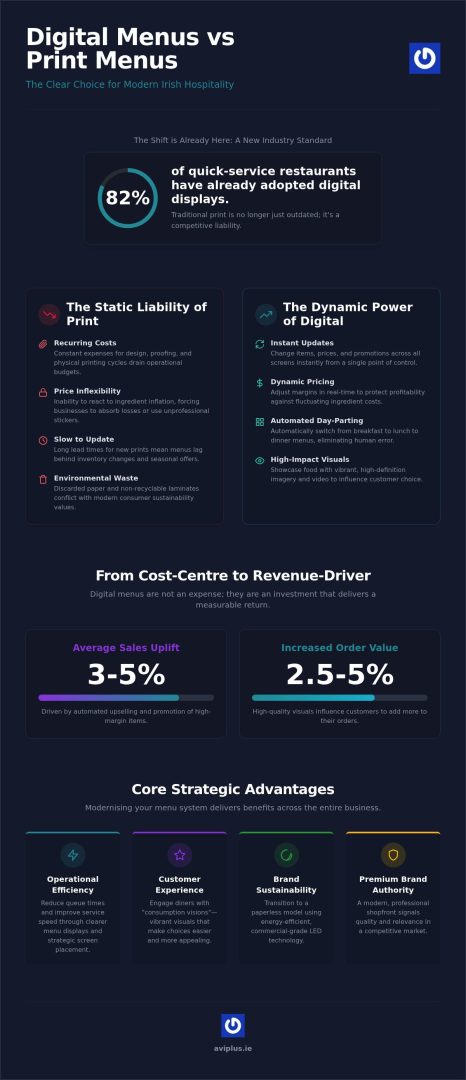
With 82% of quick-service restaurants now utilising digital displays, the traditional printed menu has transitioned from a standard tool to a significant operational liability. You’ve likely felt the frustration of rising professional printing costs or the awkwardness of telling a customer that a dish is out of stock because you couldn’t update your physical boards in time. When comparing the benefits of digital menus vs print, it’s clear that static paper can’t keep pace with the 2026 Irish hospitality market, where inflation requires instant pricing agility and total inventory transparency.
We understand that making the switch feels like a major technical leap, but it’s one that yields immediate, measurable results. This article will show you how transitioning to digital menu boards can increase your average order value by up to 5% and drastically reduce your long-term operational overheads. We’ll explore the clear business case for modernisation, from navigating Local Enterprise Office grants to creating a more attractive, high-performance shopfront that secures your competitive edge in a crowded market.
Key Takeaways
- Understand how to replace recurring printing expenses with dynamic pricing strategies that protect your margins against ingredient inflation.
- Evaluate the core benefits of digital menus vs print, specifically how high-quality visuals can influence customer choice and drive higher-margin sales.
- Learn how to reduce queue times and improve service efficiency in high-traffic Dublin locations through strategic screen placement.
- Discover the sustainability advantages of transitioning to a paperless model using energy-efficient, commercial-grade LED technology.
- Identify the essential technical factors for a successful rollout, including the necessity of high-brightness displays for varied lighting environments.
Why Irish Hospitality is Moving Away from Traditional Print Menus
A digital menu system is far more than a high-definition replacement for a chalkboard. It functions as a dynamic business tool that bridges the gap between your kitchen’s inventory and your customer’s appetite. In the current Irish hospitality sector, the evolution of the modern menu has reached a critical tipping point. Business owners are moving away from passive information displays toward active sales engines that can be updated with a single keystroke. This shift isn’t just about aesthetics; it’s a strategic response to a market where 82% of quick-service restaurants have already adopted digital displays to manage high-volume trade.
When we analyse the benefits of digital menus vs print, the most striking difference is the transition from a cost-centre to a revenue-driver. Traditional print menus represent a recurring drain on resources, requiring constant investment in design, proofing, and physical production. Conversely, a commercial-grade digital board serves as a one-time infrastructure investment that actively works to increase your margins. By 2026, Irish consumers have come to expect a level of visual engagement that paper simply cannot provide, making digital adoption a necessity for brand relevance.
The Problem with Permanent Print
The primary weakness of paper is its “static liability.” In an era of fluctuating supply chain costs and high inflation, the inability to update prices instantly is a significant threat to profitability. If an ingredient price spikes on Tuesday, a printed menu forces you to either absorb the loss or use unsightly stickers to hide the old price. Professional printing services in Ireland have seen rising costs, and the turnaround time for high-quality laminates often leaves businesses trailing behind market changes. Beyond the financial drain, the environmental impact of discarded paper and non-recyclable plastic coatings increasingly clashes with the sustainability values of the modern Irish diner.
Digital Menus as a 2026 Standard
The hospitality landscape in Dublin and across Ireland has been reshaped by the demand for “consumption visions.” Customers no longer want to guess what a “Signature Burger” looks like; they expect to see it in high-definition glory. Digital menu boards allow you to showcase steam rising from a dish or the crisp texture of a garnish, triggers that physical menus can’t replicate. This modernisation does more than just look professional; it establishes a sense of premium brand authority. By implementing benefits of digital menus vs print strategies, such as day-parting to switch from breakfast to lunch menus automatically, you eliminate human error and ensure your shopfront always presents your most profitable offerings at the right time.
The Financial Argument: ROI and Long-Term Cost Savings
Whilst the initial capital outlay for a digital system is higher than a single print run, the long-term fiscal trajectory is far more favourable for Irish businesses. When evaluating the benefits of digital menus vs print, you must look beyond the purchase price and consider the total cost of ownership. Print is an ongoing operational drain; every minor menu tweak or seasonal change requires a full cycle of design, proofing, and production. Digital boards eliminate these recurring fees entirely, allowing you to reallocate those funds into higher-quality ingredients or improved guest experiences.
One of the most potent financial advantages is the ability to implement dynamic pricing. In a volatile economy where ingredient inflation can shift weekly, digital systems allow you to adjust your margins in real-time. You don’t have to wait for a new batch of menus to arrive to protect your profits. This agility is a cornerstone of the latest restaurant technology trends, where integrated systems allow for price synchronisation across all customer touchpoints instantly. By responding to market shifts immediately, you ensure that your business remains profitable regardless of supply chain fluctuations.
Data from 2026 indicates that businesses switching from static to digital menu boards report an average sales uplift of 3-5%. This growth is driven by the power of high-impact visuals that facilitate automated upselling. Digital displays can highlight high-margin sides, premium beverages, or limited-time offers with far more efficacy than a static list. Industry research shows that digital menu boards can increase the average order value by 2.5% to 5%, effectively turning every transaction into a more profitable interaction without requiring additional effort from your front-of-house team.
Calculating the Payback Period
For most Irish takeaways and cafes, the payback period for a professional digital installation typically falls within a 12 to 18-month window. Return on Investment (ROI) in the context of digital signage is defined as the point where the cumulative savings from eliminated print costs and the incremental profit from increased order values exceed the initial hardware and installation expense. Because professional commercial screens are built for 24/7 operation, they offer a lifespan that far exceeds consumer-grade TVs, ensuring your investment continues to pay dividends for years after the initial cost is recouped.
Eliminating the “Hidden Costs” of Print
Manual menu management carries significant hidden labour costs. The time staff spend updating chalkboards, swapping out menu inserts, or explaining that certain items are out of stock represents hours of lost productivity. When an item sells out, a digital system allows you to remove it instantly, preventing customer disappointment and wasted service time. Working with reputable commercial screen suppliers Ireland ensures that you are investing in reliable hardware that minimises downtime. If you’re ready to stop the financial leak caused by traditional paper, you might consider exploring professional-grade display options tailored for the Irish market.
Enhancing Customer Experience and Operational Agility
Modern hospitality thrives on the speed of service and the clarity of the offering. In high-traffic Dublin locations, reducing queue times is essential for maintaining customer satisfaction and maximising throughput. One of the primary benefits of digital menus vs print is the ability to create “consumption visions” through high-definition imagery. Unlike a static list, dynamic displays trigger an immediate appetite response, helping customers make decisions faster. Research indicates that digital systems offer a 29% faster content turnaround time compared to traditional print, allowing your team to focus on service rather than manual updates.
Operational agility becomes a reality through automated day-parting. This technology ensures your breakfast menu vanishes and your lunch offering appears exactly when it should. It eliminates the confusion caused by outdated physical boards and ensures your kitchen isn’t taking orders for items that aren’t currently being served. Furthermore, post-pandemic hygiene remains a priority for many Irish diners. Touchless digital displays provide a cleaner, more modern alternative to shared physical menus that require constant sanitisation, reinforcing a premium brand image from the moment a customer enters.
The Psychology of Visual Ordering
Visual ordering significantly reduces “order anxiety,” especially amongst customers exploring global cuisines like South Asian or Middle Eastern flavours, which are trending across Ireland in 2026. High-quality video can showcase the texture and preparation of a dish, building trust before the first bite is taken. Implementing professional digital menu boards Ireland solutions allows you to highlight high-margin specials with animation that draws the eye far more effectively than a standard chalkboard. This approach doesn’t just sell food; it guides the customer through a curated dining experience.
Operational Agility in a Volatile Market
For businesses managing multiple locations across Dublin, Cork, or Galway, the ability to update pricing or hide out-of-stock items with a single click is a game-changer. This agility is vital when navigating local supply chain shifts or sudden VAT adjustments that require immediate menu changes. Attracting footfall from the street requires more than just internal screens; it demands high-brightness retail window display screens that remain visible even in direct sunlight. These professional-grade units ensure your brand remains the most attractive option on the high street, regardless of weather conditions or time of day.
Sustainability and Brand Perception in the Modern Marketplace
Consumer loyalty in 2026 is increasingly tied to a business’s environmental credentials. For Irish hospitality providers, the transition to a paperless model is a visible commitment to sustainability that resonates with a more conscious public. One of the most significant benefits of digital menus vs print is the immediate cessation of the “print and purge” cycle. Traditional menus, particularly those with plastic laminates, frequently end up in landfill after minor price adjustments or seasonal changes. Moving to a digital interface allows you to align your operations with the “Green Ireland” initiative and broader ESG goals without sacrificing operational efficiency.
Modern display technology has also moved far beyond the energy-heavy units of the past. Professional-grade commercial screens utilise energy-efficient LED backlighting, which consumes significantly less power than older plasma or consumer-grade televisions. This efficiency doesn’t just lower your utility bills; it ensures your shopfront remains bright and engaging whilst maintaining a lower carbon footprint. By investing in hardware designed for longevity, you avoid the environmental cost of frequent equipment replacement, a common pitfall for those using domestic-grade screens in a commercial environment.
The “Green” Business Case
Reducing physical waste is a tangible way to demonstrate your brand’s values to your customers. A paperless system eliminates the need for chemical inks, bleaches, and the transport emissions associated with frequent deliveries from printing firms. Choosing high-durability hardware is a critical part of this sustainable strategy. For instance, implementing a commercial LED wall Dublin solution provides a robust, long-term asset that outperforms temporary signage in both visual impact and lifespan. This durability ensures that your investment stays out of the waste stream for many years, providing a much higher environmental return than short-lived alternatives.
Building Brand Consistency
A modern digital aesthetic is essential for attracting a younger, tech-savvy demographic that expects seamless integration between online and offline experiences. Your digital screens should serve as an extension of your social media and website, using identical branding, colour palettes, and tone of voice. This consistency builds deep trust and justifies premium pricing by positioning your establishment as a high-end, modern destination. Beyond listing prices, these screens allow you to tell your brand story or showcase your local Irish suppliers whilst customers wait, turning a passive queue into an engaging brand experience. If you are ready to align your shopfront with modern sustainability standards, you can consult our technical team for a bespoke installation plan.
Implementing Digital Menu Boards: A Strategic Transition
Executing a successful transition to a digital system requires a methodical approach that ensures your investment delivers the expected returns. This process begins with a comprehensive assessment of your physical environment. Factors such as ambient light levels and viewing angles dictate whether you require high-brightness window displays or standard high-definition commercial screens. Getting this wrong can lead to unreadable menus and customer frustration, negating the primary benefits of digital menus vs print. A strategic rollout follows four essential stages:
- Assessment: Analysing light conditions and customer flow to determine optimal screen placement.
- Hardware Specification: Selecting commercial-grade units that are fit for the rigours of a hospitality environment.
- Content Strategy: Developing a visual hierarchy and selecting a user-friendly Content Management System (CMS).
- Professional Installation: Ensuring secure mounting and seamless technical integration with your existing network.
Once the environment is mapped, hardware selection becomes the priority. Commercial-grade screens are non-negotiable for hospitality environments. Unlike domestic televisions, these units are engineered to withstand the heat and airborne grease of a kitchen environment whilst operating 24/7. They feature professional-grade cooling systems and warranties that cover commercial usage, providing a level of reliability that consumer products simply cannot match. This durability is what secures the long-term ROI discussed earlier in this guide.
Hardware vs. Software: Getting the Balance Right
A high-end screen is only as effective as the software driving it. You need a CMS that your staff can navigate with minimal training to update prices or remove out-of-stock items instantly. Professional calibration is also vital; ensuring that the colour accuracy of your food photography matches the actual dish builds trust and enhances the appetite-triggering visuals mentioned in previous sections. Without this technical precision, your digital boards may fail to represent your brand’s quality accurately.
The AVI Plus Approach to Seamless Integration
Our approach focuses on technical excellence and local reliability. Being based in Swords, Co. Dublin, we understand that rapid response times are essential for minimising downtime in the fast-paced Irish hospitality sector. We don’t believe in one-size-fits-all mounting; instead, we provide custom mounting solutions that respect the unique architectural character of Irish venues, from modern city-centre eateries to traditional provincial establishments. This local expertise ensures that your digital transition is not only aesthetically pleasing but technically robust and easy to maintain. If you are ready to modernise your shopfront, you can contact our specialist team to discuss a bespoke installation for your venue.
Securing Your Competitive Edge in the 2026 Market
Transitioning to digital displays is no longer a luxury for Irish hospitality; it’s a strategic necessity to manage volatile costs and meet rising customer expectations. By moving away from the static liability of paper, you gain the agility to update pricing instantly and provide the high-definition visuals that modern diners demand. Recognising the benefits of digital menus vs print allows you to transform your shopfront from a cost-centre into a high-performance revenue engine.
AVI Plus provides the technical expertise and long-term support required for a seamless rollout. With over 10 years of AV experience in Ireland and a dedicated team of specialist installers based in Swords, Dublin, we ensure your hardware is perfectly calibrated for your specific space. We offer full maintenance and support contracts to give you total peace of mind that your screens will perform reliably day and night. Request a Professional Digital Menu Consultation from AVI Plus to see how we can modernise your customer experience. Embracing this technology today ensures your business stays ahead of the curve in an increasingly digital landscape.
Frequently Asked Questions
Are digital menu boards more expensive than print in the long run?
Digital systems are significantly more cost-effective over a multi-year period because they eliminate the recurring fees associated with professional design and physical printing. Whilst the initial hardware investment is higher, most Irish businesses see a full return on investment within 12 to 18 months. This financial advantage is a core part of the benefits of digital menus vs print, as it allows you to reallocate your marketing budget toward active revenue generation rather than passive paper waste.
Do digital menu boards require a constant internet connection?
A constant internet connection isn’t required for daily operation because the content is typically stored locally on the screen’s internal media player. You only need a connection when you want to push new updates, change prices, or synchronise menus across multiple locations. This ensures your menu remains visible and functional even if your local broadband experiences a temporary outage during a busy service period.
Can I use a standard domestic TV as a digital menu board?
Using a standard domestic TV is strongly discouraged because these units aren’t engineered for the heat, dust, and continuous operation of a commercial kitchen. Domestic warranties are almost always voided if the screen is used in a business setting. Commercial screens feature superior cooling systems and hardened glass, ensuring they remain reliable whilst running for 16 to 24 hours a day without the risk of panel burn-in.
How difficult is it to update prices on a digital menu?
Updating prices is an instantaneous process that can be completed from any web-enabled device using a Content Management System (CMS). You don’t need technical expertise to make changes; a few clicks allow you to adjust a single item or update an entire menu across several sites. This agility is one of the primary benefits of digital menus vs print in a market where ingredient costs can shift weekly.
What happens if the screen goes blank during service?
Commercial-grade hardware is built for high reliability, but should a failure occur, professional support contracts ensure minimal downtime. We provide maintenance agreements that offer rapid technical assistance to our clients in Dublin and across Ireland. Choosing professional installation over a DIY approach significantly reduces the risk of technical failures during peak trading hours by ensuring robust network and power connections.
Do digital menus really increase sales for small takeaways?
Small takeaways often see the most immediate impact, with industry data from 2026 showing an average sales uplift of 3-5%. High-impact visuals of high-margin items can influence customer behaviour at the point of purchase, often increasing the average order value by up to 5%. This helps smaller venues compete with larger chains by projecting a premium, modern brand image that builds immediate trust.
What is the average lifespan of a commercial digital menu screen?
A professional commercial display typically has an operational lifespan of 50,000 to 100,000 hours. This equates to over five years of continuous 24/7 use, or significantly longer if the screens are powered down outside of trading hours. This longevity far exceeds the lifespan of consumer electronics, making them a much more sustainable and reliable choice for the demanding hospitality environment.
Is there a specific VAT treatment for digital signage equipment in Ireland?
Digital signage equipment in Ireland is generally subject to the standard VAT rate of 23%. Because these systems are considered essential commercial assets, VAT-registered businesses can usually reclaim this cost as part of their regular tax filings. We always recommend consulting with your accountant to understand the specific capital allowances and tax treatments available for your technology investments under current Irish revenue guidelines.


