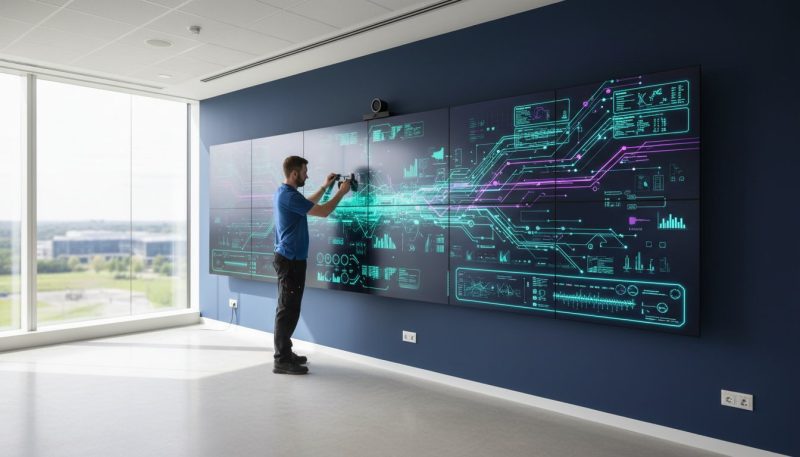
The global market for LED video wall solutions is projected to reach $6.4 billion by the end of 2026, yet many Irish businesses still struggle to distinguish between a strategic asset and a costly technical mistake. It’s understandable if you feel a sense of anxiety regarding such a significant capital investment. The pressure to choose between LCD and LED whilst deciphering complex specifications like pixel pitch and bezel width often leads to more confusion than clarity. You deserve a system that enhances your brand prestige without the fear of it becoming obsolete or difficult to maintain.
We’ve designed this guide to help you make an informed, confident decision for your commercial environment. You’ll learn how to implement high-impact displays tailored for the Irish market, ensuring you achieve a seamless finish with the peace of mind that comes from reliable local support. We will explore the practical differences between LCD and LED systems, explain critical regulatory requirements like ADA compliance, and provide a clear framework for understanding your total cost of ownership.
Key Takeaways
- Learn to differentiate between high-performance tiled LCD and seamless LED systems to ensure your technology choice aligns with your specific business goals.
- Discover how to implement high-impact video wall display solutions by accurately calculating pixel pitch and viewing distances for maximum audience engagement.
- Identify the essential hardware and software components, including controllers and CMS, required to manage and schedule sophisticated visual content.
- Understand the necessity of professional site surveys to assess structural integrity and ensure a safe, compliant installation in your facility.
- Gain insights into the end-to-end process of bespoke design and commissioning provided by a local Irish partner with dedicated support across the Leinster region.
Understanding Modern Video Wall Display Solutions for Business
A video wall is essentially a multi-monitor configuration where individual displays are tiled together to create a single, expansive visual canvas. Whilst large-scale projection was once the primary choice for big rooms, modern video wall display solutions have largely superseded it. This transition is driven by the need for superior brightness, higher contrast ratios, and the ability to function effectively in environments with high ambient light. Unlike a single large screen, a tiled system offers a modular approach, allowing businesses to create bespoke shapes and sizes that fit their unique architectural requirements.
For organisations requiring technical solutions for live and hybrid environments, straightst.com serves as an excellent example of how professional event production can be scaled to meet complex visual demands.
It’s vital to distinguish between professional-grade panels and standard consumer televisions. Commercial screens are purpose-built for the rigours of 24/7 operation. They incorporate industrial-grade power supplies and sophisticated thermal management systems to prevent hardware fatigue. If you use a consumer TV for digital signage, you’ll likely face image retention issues and premature failure. Investing in commercial hardware ensures your display remains vibrant and reliable throughout its lifecycle, protecting your initial capital outlay.
The Evolution of Large-Scale Visuals
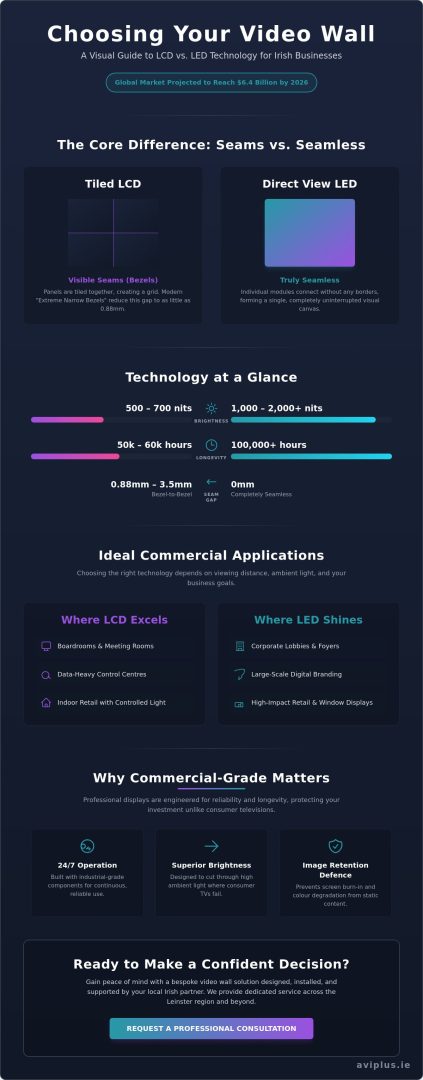
Visual technology has advanced rapidly from the days of bulky plastic bezels that interrupted the flow of content. Modern LCD panels now feature “extreme narrow bezels,” reducing the gap between screens to a fraction of a millimetre. This creates a nearly seamless viewing experience for high-resolution graphics. Simultaneously, the rise of Direct View LED (DV-LED) has redefined what’s possible for large spaces. Because LED modules lack borders entirely, they provide a truly continuous image. This Video wall technology allows for incredible flexibility, whilst 4K and 8K processing ensures that even the most massive installations deliver pin-sharp clarity for every viewer.
Key Commercial Applications in Ireland
Within the Irish commercial sector, video walls have become a hallmark of prestige and efficiency. In the corporate lobbies of Dublin business parks, these displays serve as high-impact welcome boards that communicate brand values to clients and stakeholders. Retailers in major shopping centres across the country use them to replace static posters, allowing for dynamic content updates that reflect real-time promotions. Additionally, logistics and security firms in Leinster utilise these systems in command and control centres. The vast screen real estate is essential for monitoring complex data feeds and security footage simultaneously, providing a comprehensive overview that a single monitor cannot offer.
LED vs. LCD: Comparing the Two Core Technologies
Selecting the right technology for your video wall display solutions requires a clear understanding of your environment and viewing requirements. Whilst both systems deliver high-impact results, they serve distinct purposes. LCD remains the standard for detail-oriented tasks in smaller spaces, whilst LED has become the definitive choice for seamless, large-scale visual branding. Identifying which system suits your building’s architecture is the first step toward a successful, long-term installation.
LCD systems utilise a “bezel-to-bezel” (BtB) measurement to describe the physical gap between active screen areas. Even with modern engineering, a thin line remains visible where the panels meet. In contrast, LED modules are borderless, allowing for a completely uninterrupted canvas. LED technology also offers a significant advantage in longevity, often providing up to 100,000 hours of operation before reaching half-brightness, whereas professional LCD panels typically reach this point closer to 50,000 to 60,000 hours. Regarding light output, standard commercial LCD panels usually range from 500 to 700 nits, whilst high-performance LED walls can easily exceed 1,000 to 2,000 nits.
LCD Video Walls: Bezel Width and Tiling
LCD technology is particularly effective for boardroom presentations and data-heavy displays where users stand close to the screen. To minimise visual interruptions, manufacturers have developed “Extreme Narrow Bezel” options. These panels reduce the total gap to between 0.88mm and 3.5mm, making the grid almost imperceptible from a distance. This solution is highly cost-effective for indoor environments with controlled lighting where 4K resolution is required at a smaller scale. Maintenance is also straightforward; if a single panel is damaged, it can be replaced within the array, though it requires precise colour-calibration to ensure it matches the rest of the wall.
Direct View LED (DV-LED): Seamless and Bright
Direct View LED is rapidly becoming the preferred choice for corporate lobby displays and high-end retail storefronts. Known as “Fine Pitch LED” when used indoors, these systems offer a zero-gap finish that creates a truly immersive experience. According to standards promoted by AVIXA, the Audiovisual and Integrated Experience Association, the lack of bezels is crucial for maintaining content integrity across massive scales.
The modular nature of LED allows you to create non-standard shapes, including curved walls or displays that wrap around architectural pillars. This flexibility is unmatched by LCD. Because LED panels emit light directly, they maintain exceptional clarity even in sunlight-flooded atriums or window displays. If you’re unsure which technology fits your specific space, you can explore our range of LED walls and commercial screens to see how these systems perform in real-world Irish installations.
Essential Components: Beyond the Display Panels
Whilst the panels are the most visible part of any video wall display solutions, the underlying infrastructure determines the system’s actual performance. A high-resolution screen is only as good as the signal it receives and the hardware that supports it. To achieve a professional finish, you must look beyond the glass and consider the processing, mounting, and distribution components that form the backbone of the installation. A failure in any of these areas can lead to poor image quality, difficult maintenance, or system downtime.
Mounting hardware is frequently overlooked but remains critical for long-term reliability. We advocate for precision-engineered pop-out brackets. These allow individual panels to be extended forward with a simple press, providing immediate access to the rear for maintenance or cabling adjustments. Without these, servicing a central panel in a large array becomes a complex and risky operation. It’s a standard that prevents unnecessary downtime and protects your investment from accidental damage during routine checks.
Signal distribution requires robust architecture like HDBaseT or AV-over-IP. These technologies allow high-definition signals to travel over long distances without degradation. For larger Irish corporate campuses or multi-floor retail centres, AV-over-IP provides the scalability needed to distribute content from a central server to multiple display points across a local network. This ensures that the visual impact remains consistent, regardless of the distance between the source and the screens.
Video Wall Controllers and Processing
The controller acts as the system’s brain. It manages how content is sliced and mapped across the tiled panels. Hardware-based controllers are often preferred for high-security environments because they don’t rely on a traditional operating system, making them less susceptible to crashes or external threats. These units facilitate multi-windowing, allowing you to display a mix of live video feeds, static branding, and data dashboards simultaneously. Crucially, they ensure frame-accurate synchronisation. This prevents the jarring “tearing” effect where fast-moving images appear disconnected across panel boundaries.
Content Management Systems (CMS)
Your Content Management System (CMS) allows you to organise and schedule visuals with precision. Many Irish businesses opt for cloud-based platforms for their ease of remote access, whilst others prefer on-premise solutions for strict data sovereignty. A sophisticated CMS can integrate real-time data feeds, such as social media updates or emergency alerts. For a deeper look at developing a robust visual plan, our Digital Menu Boards Ireland guide offers valuable insights into content strategy that apply across all large-scale display formats. This ensures your investment continues to deliver value long after the initial installation.
Planning Your Installation: Critical Factors for Success
Implementing video wall display solutions involves more than just selecting high-end hardware. It requires a meticulous engineering approach to ensure the system remains safe, functional, and visually impressive. Skipping the planning phase often leads to structural issues or poor image quality that cannot be easily rectified once the screens are mounted. You should treat the installation as a permanent architectural integration rather than a simple hardware addition. For a detailed engineering roadmap covering structural requirements and signal synchronisation, our guide to commercial video wall installation provides a thorough step-by-step framework for achieving a perfectly aligned, premium result.
Environmental factors like heat dissipation are vital for the longevity of your system. Large-scale displays generate significant thermal energy. Without adequate ventilation or integrated cooling paths, internal components can overheat, leading to colour shifting or total panel failure. Similarly, your electrical infrastructure must be robust. We recommend dedicated circuits for the video wall to prevent interference from other office equipment. Integrating an Uninterruptible Power Supply (UPS) is a prudent choice to protect your hardware from the voltage fluctuations occasionally found in commercial zones. To ensure your project starts on the right track, you can book a professional installation and site survey with our Dublin-based team.
Site Survey and Structural Requirements
A professional site survey is the cornerstone of a successful project. We must assess the load-bearing capacity of your chosen wall. Whilst concrete or brick provides a solid foundation, modern Irish office spaces often utilise plasterboard partitions that require significant internal reinforcement before they can support the weight of a multi-panel array. Floor-to-ceiling heights also dictate the scale of your LED wall, as you must leave sufficient clearance for ventilation and access. We also determine whether your space suits front-service or rear-service access. Front-service panels are ideal for tight spaces where the wall is flush, allowing technicians to remove modules from the front without dismantling the entire structure.
Viewing Distance and Pixel Pitch Optimisation
Pixel pitch refers to the distance between the centres of two adjacent pixels, measured in millimetres. This measurement is the primary factor in determining how clear your content appears from specific distances. As a general industry standard, we apply the “1mm per 1 metre” rule. For instance, a 1.5mm pixel pitch is ideal for a viewing distance of approximately 1.5 metres. A finer pixel pitch reduces the visibility of individual pixels at close range, ensuring that high-resolution imagery remains crisp and legible for viewers standing near the display. Choosing a pitch that is too wide for your space results in a pixelated look that diminishes your brand’s prestige.
Why AVI Plus is Ireland’s Premier Video Wall Partner
Choosing a partner for your video wall display solutions is a decision that impacts your brand’s visual identity for years. As an Irish-owned company based in Swords, AVI Plus provides a level of local accountability that international vendors simply can’t match. We understand the specific architectural and commercial requirements of businesses across Leinster. Our role is to act as a dedicated guide, transforming complex technical requirements into a streamlined, high-performance reality that serves your business goals.
We don’t just supply hardware; we provide a comprehensive end-to-end service. This process begins with a detailed consultation and continues through the creation of precise CAD drawings to ensure every panel fits perfectly within your environment. Our engineers manage the entire lifecycle of the project, from the initial site survey to the final commissioning of the system. This holistic approach ensures that your communication challenges are solved with a bespoke solution rather than a one-size-fits-all product.
Reliability is the cornerstone of our service model. We offer comprehensive AV support and maintenance contracts designed to ensure 99.9% uptime for your displays. A video wall that sits dark or malfunctioning is a liability to your corporate prestige. By providing proactive care and rapid-response technical assistance, we ensure your investment remains a vibrant and effective asset for your organisation. Our local presence in Swords allows us to reach Dublin-based clients quickly, minimising potential downtime.
Professional Installation and Support in Dublin
Our team of qualified engineers manages the entire physical setup with a focus on clean, professional aesthetics. We prioritise invisible cabling and precision alignment to create a seamless finish that complements your interior design. For businesses in Swords and the wider Dublin area, our local expertise means we can provide ongoing technical support without the delays associated with non-local providers. We take pride in the technical mastery required to align multi-panel arrays to sub-millimetre tolerances, ensuring a perfect visual canvas.
The AVI Plus Commitment to Quality
We utilise only premium, commercial-grade components to ensure maximum longevity and superior performance in demanding environments. Our commitment doesn’t end once the screens are mounted and the video wall display solutions are active. We provide thorough post-installation training to ensure your team can manage and schedule content with absolute confidence. If you’re ready to enhance your facility with a professional system, contact our Swords office for a bespoke video wall consultation.
Transform Your Commercial Environment with Precision Visuals
Integrating video wall display solutions requires a strategic balance of high-end hardware and meticulous planning. You’ve seen how the choice between LCD and LED technology hinges on your specific lighting conditions and viewing distances. Success also depends on the invisible infrastructure, including robust controllers and professional mounting systems. By prioritising a professional site survey and considering the total cost of ownership, you can ensure your installation remains a prestigious asset rather than a technical burden.
AVI Plus has been Irish-owned and operated since 2017, specialising in commercial-grade 24/7 display technology. Our team provides full technical support and maintenance from our base in Swords, Co. Dublin. We manage every detail, from initial CAD drawings to ongoing system optimisation, giving you peace of mind that your investment is protected. Request a bespoke Video Wall consultation with our Swords-based experts to begin your journey. We look forward to helping you achieve a seamless, high-impact visual experience that resonates with your audience.
Frequently Asked Questions
What is the difference between an LCD and an LED video wall?
LCD systems comprise tiled liquid crystal panels with thin borders; LED technology uses modular diodes for a truly seamless finish. LED is the superior choice for high-brightness environments like atriums because it lacks the reflective glass found on LCDs. Conversely, LCD provides exceptional pixel density for boardrooms where viewers need to read fine text or complex data charts from a short distance.
How long does a commercial video wall typically last?
A commercial-grade LED wall typically operates for up to 100,000 hours before the light output drops to half its original intensity. Professional LCD panels are generally rated for 50,000 to 60,000 hours of continuous use. Achieving these lifespans depends on maintaining a stable temperature and ensuring the system is powered by clean, regulated electricity to prevent component fatigue.
Can I use regular TVs to create a video wall for my business?
You shouldn’t use regular televisions for a business installation. Consumer screens aren’t built for 24/7 operation and will likely suffer from image “burn-in” or hardware failure within months. They also feature wide plastic bezels that create large gaps in your visual. Commercial-grade screens include industrial cooling and thin bezels designed specifically for the rigours of a tiled environment.
What is pixel pitch, and why does it matter for my office?
Pixel pitch is the measurement in millimetres between the centres of individual pixels on an LED display. It’s the most critical factor in determining image clarity relative to viewing distance. In an office setting, a fine pixel pitch is necessary so that employees can view presentations and spreadsheets without seeing a “screen door” effect or individual dots of light.
How do I manage the content on a large-scale video wall?
You can manage your visuals through a Content Management System (CMS) that allows for remote scheduling and layout control. High-quality video wall display solutions often utilise cloud-based platforms, enabling your marketing team to push updates to the screen from any location. This software handles everything from simple image carousels to complex, multi-window data feeds that update in real-time.
What are the power and cooling requirements for a video wall?
Large-scale displays require dedicated electrical circuits to handle the startup current and ongoing load. It’s also vital to integrate an Uninterruptible Power Supply (UPS) to shield the sensitive electronics from voltage spikes. Regarding cooling, you must provide adequate ventilation behind the panels to prevent heat buildup, which can lead to colour shifting and shortened hardware life.
Do video walls require regular maintenance?
Yes, regular maintenance is vital for protecting your investment and ensuring 99.9% uptime. This includes physical cleaning to remove dust from cooling fans and the screen surface. Technicians also perform colour calibration to ensure that all panels in the array match perfectly, alongside firmware updates that keep the video wall controller and CMS running securely and efficiently. For a comprehensive overview of what this entails, our video wall maintenance checklist for Irish businesses outlines every essential routine and technical check required to protect your hardware investment.
Is a video wall controller always necessary?
A dedicated controller is almost always necessary for professional applications. Whilst some screens offer basic daisy-chaining, they can’t handle complex windowing or manage multiple input sources simultaneously. A controller provides the processing power needed for frame-accurate synchronisation across all panels. This prevents visual tearing and allows you to create bespoke layouts that fit your specific communication needs.