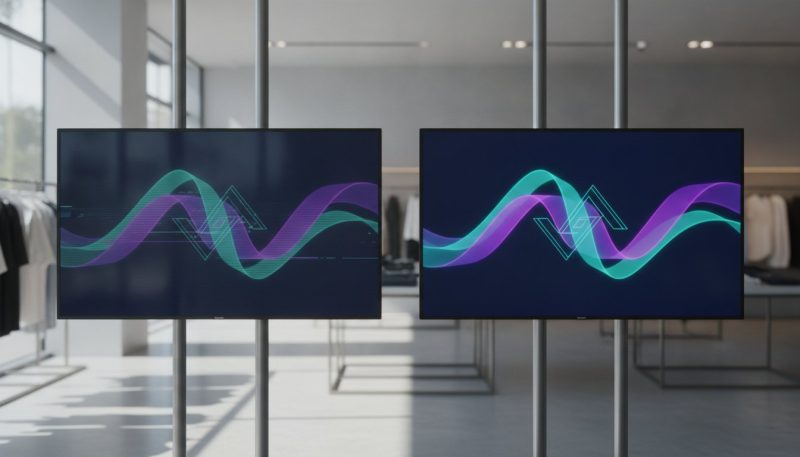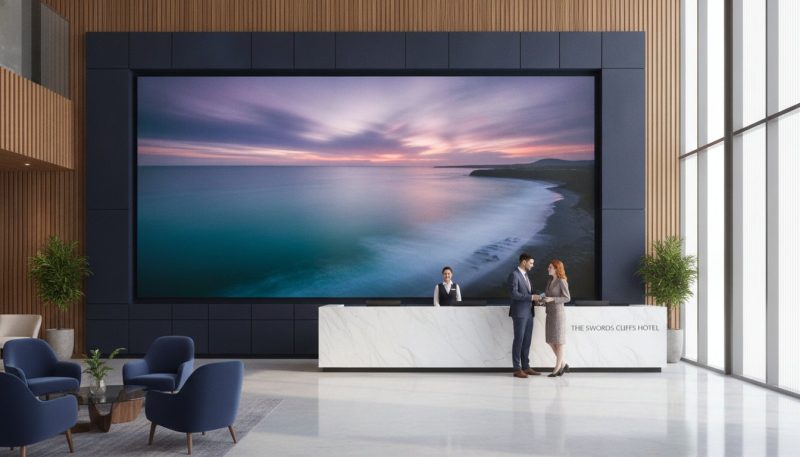
Did you know that pedestrians are 10 times more likely to notice dynamic digital signage than a static poster? Despite this, many storefronts still struggle with screens that look washed out in the midday sun or content loops that feel repetitive and uninspired. If your current strategy involves simply mirroring your social media feed, you’re missing a massive opportunity to capture attention. To truly stand out, you need high-impact digital window display content ideas that respect the three-second rule and compel passersby to stop and enter your premises.
We understand that finding the time to create professional-grade visuals whilst managing daily operations is a constant challenge. You want a storefront that reflects the premium quality of your brand without requiring a full-time design team. This guide provides a curated selection of professional strategies designed to transform your window into a high-conversion digital asset. We’ll explore 15 creative concepts, ranging from real-time data triggers to localised community engagement, ensuring your displays remain fresh and drive measurable footfall throughout 2026.
Key Takeaways
- Master the “3-second rule” by deploying high-impact visuals that capture pedestrian attention before they pass your storefront.
- Explore 15 strategic digital window display content ideas, including weather-triggered promotions and localised user-generated content, to keep your messaging relevant.
- Enhance screen visibility by prioritising high-contrast designs and ensuring all text remains legible from at least five metres away.
- Leverage industry-specific strategies for Irish high streets, focusing on silent communication that doesn’t rely on audio to deliver its message.
- Prevent screen fatigue by implementing day-parting schedules that tailor your content for morning, lunch, and evening audiences.
The Science of the Stop-and-Stare: Why Window Content is Different
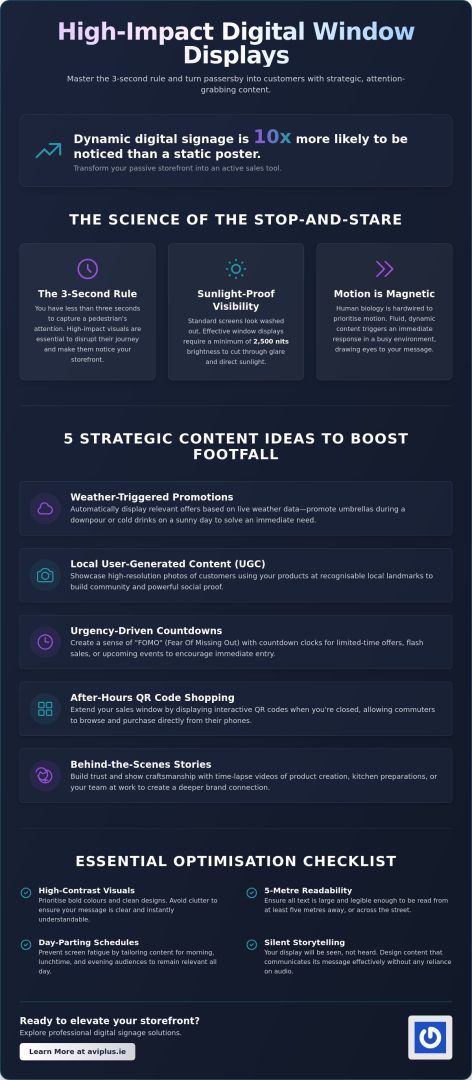
Capturing the attention of a busy pedestrian requires a strategy fundamentally different from internal digital communication. We define “Stop-and-Stare” content as high-impact, short-dwell-time visuals engineered to disrupt the autopilot mode of high-street shoppers. Whilst an internal screen might have minutes to deliver a message, a window display operates under the strict “3-second rule”. In less time than it takes to draw a breath, a passerby decides whether your storefront is worth their time or if they should continue their journey. If your digital window display content ideas don’t land an immediate punch, they’ve already failed.
To compete with the ambient light of an Irish afternoon, hardware specifications are just as vital as the creative itself. Standard commercial screens often disappear behind reflections; effective window displays require a minimum of 2,500 nits of brightness to remain visible in direct sunlight. When you combine this technical power with dynamic storytelling, the results are transformative. Verified research indicates that customers are 10 times more likely to observe dynamic digital signage content than static messages. This shift from “frozen” posters to fluid motion can increase observation rates dramatically, turning a passive storefront into an active sales tool.
The Psychology of High-Street Pedestrians
Human biology is hardwired to prioritise motion in our peripheral vision. This evolutionary trait is the foundation of successful retail engagement. In a crowded environment like a Dublin shopping centre, your screen must use movement to trigger an immediate response. Colour psychology also plays a pivotal role. In Irish retail, warm tones and high-contrast palettes often outperform muted aesthetics, as they provide a sense of energy against often grey weather. The key is balance. You must maintain brand elegance whilst ensuring text is bold enough to be read from across the street. Cluttered designs are the enemy of conversion; simplicity always wins the three-second race.
Digital vs. Traditional Window Dressing
Traditional print media is static, expensive to update, and quickly becomes background noise. Transitioning to Digital Signage allows for a level of agility that print simply cannot match. You can react to real-time events instantly, such as launching a flash sale during a sudden downpour or updating a menu board as stock levels change. This cost-efficiency removes the recurring overheads of physical installation and printing. For those deciding on the best hardware for these environments, our LCD vs LED for window displays guide provides a detailed breakdown of which technology suits your specific storefront requirements.
15 Strategic Digital Window Display Content Ideas
Generating high-impact digital window display content ideas requires a shift from passive broadcasting to active engagement. To truly boost footfall, your content must address the immediate needs or curiosities of the person standing on the pavement. We recommend starting with hyper-local, weather-triggered promotions. By integrating live weather data, your screens can automatically switch to featuring umbrellas or waterproof gear the moment a Dublin downpour begins. This relevance transforms a generic screen into a helpful, real-time advisor that solves a problem exactly when it arises.
User-generated content (UGC) is another powerful tool for local resonance. Displaying high-resolution photos of customers using your products at recognisable Dublin landmarks creates an immediate sense of community and social proof. However, legibility is paramount. Avoid cluttered social feeds; instead, curate single, striking images with bold, high-contrast captions that can be read from five metres away. Adding countdown clocks for limited-time offers or grand opening events further drives urgency, using visual “FOMO” to encourage immediate entry into the store.
For businesses looking to extend their sales window, interactive QR codes are essential. By displaying a “window shopping” gallery after hours, you allow commuters to scan and purchase items directly from their phones whilst your doors are locked. Pairing this with “Behind the Scenes” time-lapse videos of product creation or kitchen preparation adds a layer of transparency and craftsmanship that builds a deeper connection with your brand. If you are considering how to implement these technical features, our team provides expert installation and support to ensure your hardware handles dynamic content seamlessly.
Showcasing Products and Services
- 3D Product Rotations: Use smooth, slow-motion 3D renders to reveal intricate details and textures that are often missed on a physical shelf.
- Problem vs. Solution Splits: Utilise animated split-screens to demonstrate the immediate benefits of your service, such as a “before and after” visual for a cleaning or repair business.
- Real-time Stock Alerts: Create a sense of exclusivity by displaying live stock levels for “trending” or “limited edition” items, encouraging shoppers to act before they sell out.
Building Trust and Authority
Industry-Specific Strategies for Irish Businesses
Effective digital window display content ideas must be rooted in the specific geography and pedestrian behaviour of your storefront. For example, a shop on a high-dwell-time street in Swords requires a different content rhythm than a unit in Dublin’s busy city centre. Commuters in transit have different visual needs than weekend shoppers. Your content loops should match these local behaviours, ensuring that the most vital information is delivered within the specific window of time a pedestrian spends in front of your glass. If your screen is located near a bus stop or a busy crossing, you have the luxury of longer content sequences; if it’s on a narrow, fast-paced pavement, your message must be instantaneous.
Visuals must succeed without sound to be effective in a retail environment. Glass is a natural acoustic barrier, and high-street noise makes external speakers impractical and often intrusive. We advocate for “silent communication,” where every message is conveyed through bold typography and high-definition motion. If you are in the food or hospitality sector, this visual-first approach is even more critical. You can see how this applies to the restaurant industry in our guide to digital menu boards Ireland, which details how to use high-contrast imagery to drive hunger and interest without relying on audio.
Digital screens shouldn’t exist in a vacuum. They work best when integrated into your existing physical window dressings. Use your screen as a dynamic backdrop for physical mannequins or product displays. This hybrid approach creates a sense of depth and professionalism that purely digital or purely physical windows often lack. By blending physical textures with digital movement, you create a multi-dimensional experience that is much harder for a passerby to ignore.
Estate Agents and Property Professionals
For property professionals in North Dublin, screens offer a chance to showcase listings with more than just a static photo. Full-screen virtual tours of premium listings allow buyers to see the interior of a Swords apartment without ever entering the office. You can also implement live “New to Market” tickers that update automatically from your CRM, creating a sense of urgency. Local area guides featuring maps of nearby schools and amenities provide immediate value to prospective buyers, positioning your agency as a knowledgeable local partner.
Retail and Boutique Fashion
Boutique fashion retailers can use digital screens to overcome the limitations of physical floor space. Digital “Lookbooks” can be scheduled to change based on the time of day, showing professional workwear during the morning commute and evening wear for the after-work crowd. Slow-motion close-ups of luxury fabrics highlight the quality and texture that a standard shelf display might obscure. Integrating live social media “likes” next to specific items provides real-time social proof, showing passersby what’s currently trending amongst your online community.
Children’s Entertainment and Events
Optimising Content for Visibility: Overcoming Glare and Sunlight
Sunlight is the primary adversary of any storefront screen. Even the most creative digital window display content ideas will fail if they aren’t visible against the harsh glare of a south-facing window. To maintain clarity, we recommend a high-contrast design philosophy. Dark backgrounds with light, bold text are far more effective than white backgrounds. This is because white pixels on a high-brightness screen can cause a “blooming” effect in direct sunlight, where the light bleeds into the surrounding area and obscures your message. By choosing deep blues, blacks, or dark greys for your canvas, you allow the illuminated text to punch through reflections with maximum impact.
Legibility is a non-negotiable factor for conversion. Your primary message must be readable from at least five metres away to give pedestrians enough time to process the information before they pass your door. This means avoiding “fine print” and keeping font sizes large and purposeful. Standard 700-nit consumer televisions lack the backlight power to overcome daytime reflections, resulting in a faded image that is virtually invisible to passersby. Professional window displays maintain colour accuracy and impact even when the sun is at its zenith, ensuring your brand looks premium at all hours of the day.
Design Rules for High-Brightness Screens
Colours behave differently under intense UV light. We suggest using highly saturated colours that won’t wash out when exposed to direct brightness. Negative space is equally important; by leaving room around your primary message, you prevent the screen from looking cluttered and difficult to parse. Additionally, consider your frame rate. Smooth 60fps (frames per second) motion feels more modern and professional than jerky 24fps sequences. Fluid movement is more effective at catching the eye of a pedestrian in their peripheral vision, triggering the “Stop-and-Stare” response we discussed earlier.
Hardware vs. Content Synergy
Your content must be designed to match the specific aspect ratio and resolution of your hardware. Distorted or stretched images immediately devalue your brand image. When partnering with expert commercial screen suppliers Ireland, you gain access to displays equipped with ambient light sensors. These sensors automatically dim the screen at night, preventing your shopfront from blinding pedestrians or violating local light pollution guidelines. Content choice also affects thermal management. South-facing windows can become incredibly hot, and bright, white content forces the screen to work harder. Choosing darker palettes helps the unit run cooler, protecting your investment for the long term.
If you’re ready to upgrade your storefront with high-visibility technology, contact us today for a professional window display consultation.
Managing Your Digital Storefront: Scheduling and Refreshing
The most sophisticated digital window display content ideas lose their impact if they remain static for weeks on end. Local commuters and regular shoppers quickly develop “screen fatigue” if they encounter the same loop every morning. To maintain a high level of engagement, we recommend developing a weekly content calendar that ensures your messaging remains relevant to the current day and hour. By treating your storefront like a broadcast channel rather than a fixed poster, you keep the brand experience fresh and encourage repeat observation from your most frequent passersby.
Day-parting is a fundamental strategy for high-street success. This involves scheduling specific content to match the changing demographics of the pavement throughout the day. Your morning loop might focus on quick-grab items or “on-the-go” services for the 8:00 am rush. By lunchtime, your screens should transition to promotional offers or menu highlights. Evening content can then pivot toward brand storytelling or after-hours QR codes for window shopping. Modern cloud-based management systems allow you to coordinate these updates across multiple Dublin locations from a single laptop, ensuring consistency across your entire estate without the need for site visits.
Technical reliability is the backbone of your digital strategy. A blank screen or a visible error message devalues your brand image instantly. Regular technical maintenance ensures your thermal management systems are functioning correctly and your software is up to date. This proactive approach guarantees 24/7 uptime, protecting the ROI of your hardware investment. When your system is managed correctly, it becomes a set-and-forget asset that works tirelessly to drive footfall whilst you focus on running your business.
The 5-Step Content Refresh Workflow
- Audit Footfall Data: Review which promotions coincided with higher store entry rates to refine your future loops.
- Source 4K Assets: Always use high-resolution visuals that match the native resolution of your screens to prevent blurring or pixelation.
- Organise the Playlist: Balance your loop with a mix of 60% promotional content, 20% helpful information, and 20% entertaining brand visuals.
- Test for Legibility: View the new content from the pavement during the brightest part of the day to ensure contrast levels are sufficient.
- Review Dwell Times: Adjust the duration of each slide based on whether your location is a fast-paced transit route or a high-dwell-time shopping street.
Partnering with Professional AV Installers
A professional installation is about more than just mounting a screen. Expert installers in Swords and North Dublin ensure that cable management is discrete and that airflow is optimised to prevent overheating in south-facing windows. Ongoing support and maintenance contracts provide peace of mind, ensuring that any technical hitches are resolved before they impact your sales. For those looking to make an even larger impact, our guide to commercial LED wall Dublin installations explores how large-format solutions can be managed with the same level of precision and ease.
Transform Your Storefront into a High-Performance Asset
Success on the modern high street relies on more than just high-quality hardware. It requires a strategic blend of high-contrast design, purposeful day-parting, and hyper-local relevance to disrupt the autopilot mode of busy pedestrians. By moving away from static posters and embracing dynamic storytelling, you transform your window into a proactive sales tool that works as hard as your team. Implementing these digital window display content ideas ensures your brand remains visible against the midday sun whilst capturing the attention of your specific local audience.
Based in Swords, Co. Dublin, AVI Plus is your dedicated partner for professional retail technology. We are specialists in high-brightness commercial displays and provide full installation and maintenance support to protect your investment for the long term. If you’re ready to professionalise your brand image and drive measurable engagement, book a professional window display consultation with AVI Plus. Your storefront is the first point of contact with your customer; we’ll help you make every second count.
Frequently Asked Questions
What is the best type of content for a retail window display?
The best type of content for a retail window display is high-contrast, bold-motion visual storytelling that respects the “3-second rule”. Successful digital window display content ideas focus on a single, clear message rather than cluttered information. You should prioritise vibrant colours and large typography that remains legible from at least five metres away, ensuring your storefront stands out on a busy high street.
How often should I change the content on my digital window screens?
You should refresh your core content loop at least once a week to prevent screen fatigue amongst local commuters and regular shoppers. Implementing day-parting strategies allows you to change content multiple times a day to match the morning rush, lunch crowd, and evening pedestrians. Regular updates ensure your storefront remains a dynamic point of interest rather than becoming static background noise.
Can people see digital window displays in direct sunlight?
Yes, people can see digital window displays in direct sunlight provided you use high-brightness commercial screens rated for 2,500 nits or higher. These professional units are specifically engineered to punch through glass reflections and intense UV glare. Standard consumer televisions lack this backlight power and will appear washed out or completely invisible during the brightest parts of the day.
Do I need a graphic designer to create digital signage content?
You don’t strictly need a graphic designer, as many modern digital signage platforms offer professional templates and user-friendly creation tools. However, for high-end brands, investing in bespoke professional-grade visuals can significantly enhance your brand image. The priority should always be high-resolution assets that match the screen’s native 4K resolution to ensure a polished and authoritative appearance.
What is the “3-second rule” in digital window advertising?
The “3-second rule” refers to the critical window of time a pedestrian takes to decide whether to engage with your storefront or ignore it. Your content must communicate its value proposition or primary offer instantly. If a passerby cannot understand your message within three seconds, they will likely continue walking without entering your premises or noticing your brand.
Is it better to use video or static images for window displays?
Dynamic video and motion graphics are significantly more effective than static images for window displays. Research indicates that customers are 10 times more likely to observe dynamic digital signage content than static messages. Motion triggers the human peripheral vision, making it an essential tool for disrupting the autopilot behaviour of pedestrians on a crowded pavement.
How do I manage content for multiple store locations in Ireland?
You can manage content for multiple store locations through a centralised, cloud-based Content Management System (CMS). This allows you to update screens in Swords, Dublin, or any other location from a single laptop. Remote management ensures brand consistency across your entire estate whilst allowing for local, site-specific promotions to be scheduled with ease.
Are digital window displays energy-efficient for 24/7 use?
Commercial window displays are designed for 24/7 operation and include energy-efficient features like ambient light sensors. These sensors automatically dim the screen at night to reduce power consumption and prevent light pollution. Additionally, professional thermal management systems ensure the screens run efficiently even in south-facing windows that are prone to significant heat build-up.